
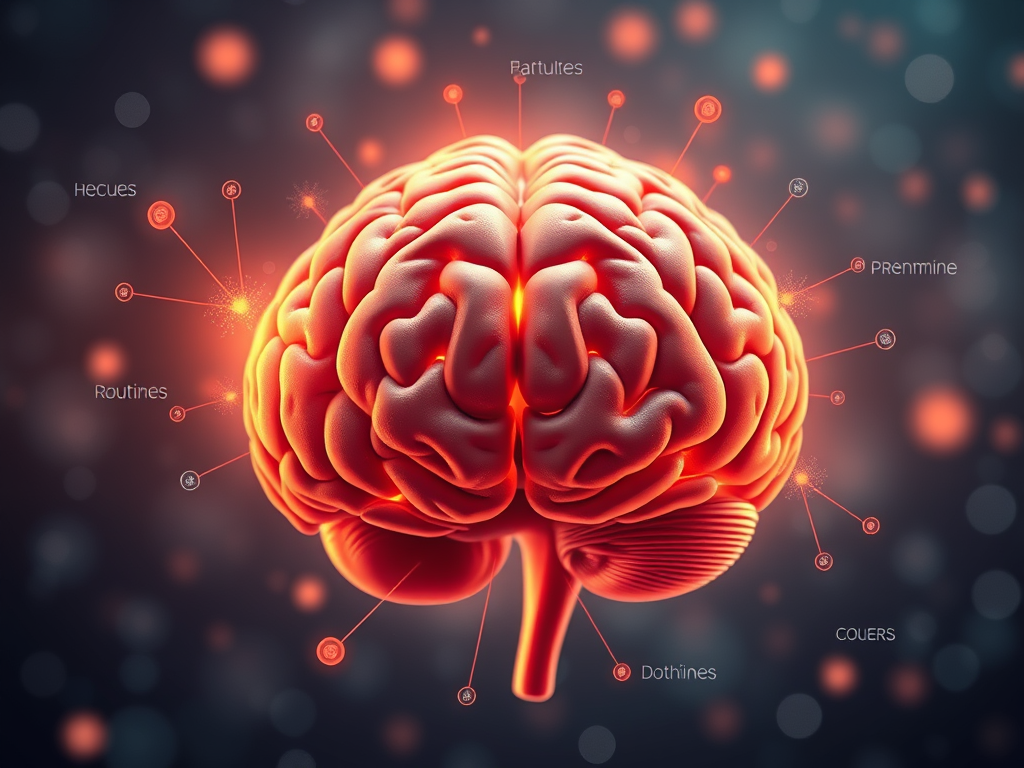
How Your Brain Builds Routines—and How to Rewire Them
Imagine brushing your teeth. You don’t deliberate. You don’t negotiate. You simply do it. Now contrast that with trying to stop late-night snacking or compulsive phone scrolling. Suddenly, every ounce of effort feels heavy.
This contrast isn’t a character flaw. It’s neuroscience.
Habits—good or bad—are not governed primarily by motivation or discipline. They are embedded systems, encoded deep within the brain’s architecture. Understanding how habits form, why they persist, and how they can be changed gives you leverage. Not force. Leverage.
At Medal Mind, we view habit change not as self-control theater, but as applied neuroscience. When you understand the machinery, you can work with it instead of fighting it.
The Habit Loop: The Brain’s Automation System
At the center of habit science is the habit loop, a framework popularized by Charles Duhigg and validated by decades of behavioral neuroscience.
The loop consists of three components:
- Cue – the trigger that initiates the behavior
- Routine – the behavior itself
- Reward – the outcome that reinforces repetition
Once established, this loop allows the brain to offload behavior from conscious decision-making to automation. That automation is not laziness—it’s efficiency.
The brain’s goal is conservation of energy. Every habit you form reduces the metabolic cost of thinking.
The Role of the Basal Ganglia: Where Habits Live
Habits are primarily encoded in the basal ganglia, an evolutionarily older structure responsible for procedural learning and automatic behavior.
When a habit is well-established:
- The prefrontal cortex (decision-making center) becomes less involved
- The behavior runs with minimal conscious oversight
- Resistance feels effortful because you are overriding automation
This explains why bad habits feel “stronger” than good intentions. You are not battling desire—you are interrupting a deeply optimized neural shortcut.
Dopamine: Why Habits Stick
Dopamine is often misunderstood as a pleasure chemical. In reality, it is a learning and reinforcement signal.
Dopamine spikes:
- When a reward is anticipated
- When a behavior successfully resolves discomfort
- When the brain predicts a positive outcome
This prediction is crucial. Over time, dopamine begins firing at the cue, not the reward. That’s why a notification sound or the sight of snacks can trigger cravings before you’ve acted.
The brain has learned the loop.


4
Why Breaking Bad Habits Feels So Hard
Breaking a habit does not erase the original neural pathway. Research consistently shows that old habit circuits remain dormant, not deleted.
To change behavior, the brain must:
- Inhibit the automatic routine
- Engage the prefrontal cortex
- Substitute a new response
This is cognitively expensive. Fatigue, stress, and distraction weaken the prefrontal cortex—precisely when bad habits resurface.
This is why habit change fails under stress, not because of weakness, but because of biology.
Interrupting the Loop: What Neuroscience Shows Works
Research from MIT and other neuroscience labs demonstrates a powerful insight:
Habits are most vulnerable at the cue and transition point—not the reward.
Change the cue, change the environment, or insert friction, and the loop destabilizes.
Effective strategies include:
- Cue disruption (changing time, place, or context)
- Routine substitution (keeping the cue and reward, changing the behavior)
- Environmental design (removing triggers, adding barriers)
This aligns with findings summarized by the National Institute on Drug Abuse and habit research across addiction and behavioral psychology: awareness plus structural change beats willpower alone.
A useful external reference on this neuroscience-backed approach is from the National Institute of Mental Health:
https://www.nimh.nih.gov/health/topics/cognitive-behavioral-therapy-cbt
The Prefrontal Cortex: Your Change Engine
The prefrontal cortex is responsible for:
- Planning
- Inhibition
- Long-term goal alignment
When you create implementation intentions—clear “if-then” plans—you preload the prefrontal cortex with decisions before the cue appears.
Example:
“If I feel the urge to snack late at night, then I will make tea and step outside for two minutes.”
This reduces real-time decision-making, conserving cognitive resources.
Cultural Forces That Reinforce Habits
Habits do not form in isolation. Modern environments are engineered for habit capture:
- Infinite scrolls
- Push notifications
- Convenience-driven consumption
Culture supplies the cues. Technology supplies the rewards. Your brain supplies the automation.
Understanding this removes moral judgment from habit struggles. You are navigating a system designed to exploit habit circuitry.
The cultural shift toward mindfulness and self-compassion reflects a growing awareness that sustainable habit change requires environment redesign—not self-punishment.
Practical Applications: Rewiring With Intention
Neuroscience-informed habit change emphasizes replacement, not eradication.
Effective approaches include:
- Habit stacking: pairing a new habit with an existing one
- Cue-awareness training: identifying emotional or situational triggers
- Friction engineering: making bad habits harder, good habits easier
Cognitive Behavioral Therapy (CBT) formalizes this process by helping individuals map cues, thoughts, behaviors, and outcomes—then systematically alter them.
When you change the loop, you change the brain.
The Real Takeaway
Habits are not personality traits. They are learned neural efficiencies.
Every habit you repeat strengthens a circuit. Every interruption weakens its dominance. Change is not instant because rewiring takes repetition—but repetition works both ways.
You do not need to erase who you are. You need to understand how you were shaped.
With awareness, structure, and patience, the same brain that trapped you in patterns can build new ones—quietly, steadily, and permanently.
For more mental health and wellness resources visit our eBooks page.


Leave a Reply