
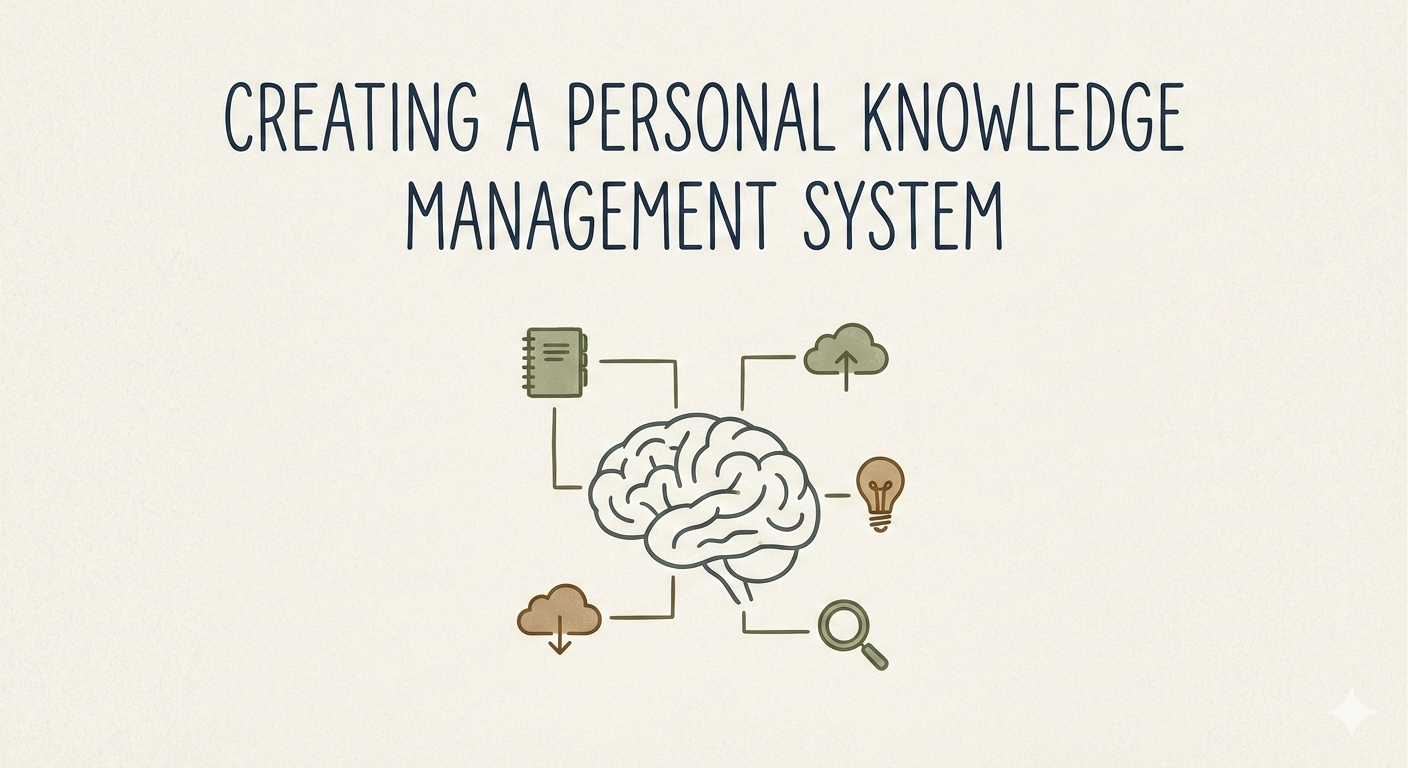
Meta Description: Creating a Personal Knowledge Management System helps you turn information overload into clear thinking, better recall, and ideas that compound over time.
Creating a Personal Knowledge Management System in an Age of Information Overload
Are you a voracious consumer of information—yet somehow, the more you learn, the less you feel you know?
You’re not broken. You’re responding normally to an abnormal environment.
We live in a hyperconnected world that rewards collection over comprehension. We read, scroll, highlight, bookmark, and save—then promptly forget. Information floods in at record speed, but meaning leaks out just as fast.
The real question isn’t how to learn more.
It’s this:
How do you turn constant input into knowledge that actually compounds?
That’s where Creating a Personal Knowledge Management System becomes transformative.
The Real Problem: We Collect Information but Fail to Internalize It
We’ve become excellent at capturing information.
We’re terrible at using it.
Tabs multiply. Notes pile up. Highlights sit untouched. What should be assets quietly become cognitive debt.
Imagine instead having a system that works with your brain, not against it—a system that captures ideas, clarifies them, and makes them usable exactly when you need them.
That’s what a Personal Knowledge Management System (PKMS) is for.
Not storage.
Not hoarding.
Leverage.
Why Creating a Personal Knowledge Management System Actually Works (The Science—But Useful)
A PKMS is effective because it aligns with two fundamental cognitive realities:
1. Your Brain Is for Creating, Not Storing
Long-term memory is associative, fragile, and highly context-dependent. When you offload information into a trusted external system, you free cognitive bandwidth for higher-order thinking—analysis, synthesis, and creativity.
2. Learning Only Sticks Through Active Engagement
Passive consumption feels productive, but it rarely leads to durable understanding. Rewriting, connecting, and applying ideas is what turns exposure into insight.
A well-designed PKMS transforms fleeting inputs into structured understanding. The result is an external thinking environment—one you can reliably think with.
The payoff:
- Sharper thinking
- Faster creation
- More original insights
- Fewer “I know I read this somewhere…” moments
The PKMS Lifecycle: A Simple, Sustainable Protocol
Think of Creating a Personal Knowledge Management System not as a folder structure—but as a lifecycle.
1. Capture: Collect Ideas While They’re Alive
Capture ideas as they appear:
- Quotes
- Insights
- Research findings
- Conversations
- Your own thoughts at 2:17 a.m.
Rule: Capture fast. Judge later.
Speed matters more than organization at this stage.
2. Curate: Turn Raw Input Into Understanding
Curation is where knowledge begins.
- Rewrite ideas in your own words
- Tag by theme or question
- Link related notes together
This step converts information into comprehension. If you can’t explain a note simply, you don’t own it yet.
Think of this as sense-making, not filing.
3. Create: Use Knowledge or Lose It
Unused knowledge decays.
Turn curated notes into:
- Writing
- Decisions
- Projects
- Experiments
Creation is where learning locks in. The act of producing something forces clarity—and reveals gaps instantly.
4. Connect: Stress-Test Ideas in the Real World
Knowledge strengthens when it leaves your head.
- Share insights
- Teach concepts
- Discuss ideas
- Invite critique
Explaining something is the fastest way to discover what you don’t yet understand—humbling, but incredibly efficient.
Step-by-Step: Creating a Personal Knowledge Management System That Lasts
Step 1: Choose Tools That Reduce Friction
Tools matter—but only after principles.
Popular options include:
- Notion
- Evernote
- Obsidian
- Mendeley
Choose tools that make capturing, linking, and retrieving effortless. Everything else is optional.
Step 2: Build a Frictionless Capture System
If capturing takes more than 10 seconds, you won’t do it consistently.
- Phone notes
- Voice memos
- One-click highlights
Capture first. Organize later.
Step 3: Curate on a Fixed Schedule
Set a weekly review.
- Rephrase notes
- Delete noise
- Strengthen connections
Think gardening, not archiving. Growth requires pruning.
Step 4: Create Directly From the System
Schedule time to pull from your PKMS.
Write from it. Plan from it. Think with it.
This is how Creating a Personal Knowledge Management System turns information into personal intelligence.
Step 5: Connect Outward for Feedback
Publish summaries. Share frameworks. Discuss insights.
Feedback isn’t validation—it’s refinement.
Common Mistakes to Avoid When Creating a Personal Knowledge Management System
- Overengineering: Complex systems collapse under their own weight
- Tool obsession: Software doesn’t replace thinking
- No reviews: Unreviewed notes become digital clutter
- Mindless capture: Save ideas with intent, not anxiety
If your system feels heavy, it’s wrong. A good PKMS should feel liberating.
Quick Start: The 15-Minute PKMS Setup
- Pick one domain (work, study, creativity)
- Use one capture tool
- Review for 15 minutes daily
- Create something small weekly
- Refine monthly
That’s it. No “second brain” required—just a functional one.
FAQs About Creating a Personal Knowledge Management System
1. What is a Personal Knowledge Management System?
A PKMS is a structured way to capture, process, and apply information so it becomes usable knowledge instead of forgotten data.
2. Do I need special software to build a PKMS?
No. Tools help, but principles matter more. Even simple notes can work if used intentionally.
3. How often should I review my notes?
Light daily reviews and deeper weekly reviews work best for long-term retention.
4. Is a PKMS the same as a second brain?
They’re related. A PKMS emphasizes thinking and creation, not just storage.
5. What if I capture too much information?
That’s normal at first. Regular curation will naturally reduce noise.
6. Can a PKMS improve creativity?
Yes. By connecting ideas across domains, a PKMS increases originality and insight.
Final Thought: Think Better, Not Just Know More
Creating a Personal Knowledge Management System isn’t about knowing more.
It’s about thinking better.
When information stops being something you consume and starts being something you shape, learning compounds—and clarity follows.
Build the system once.
Let it work for years.
And yes—your future self will thank you.



Leave a Reply