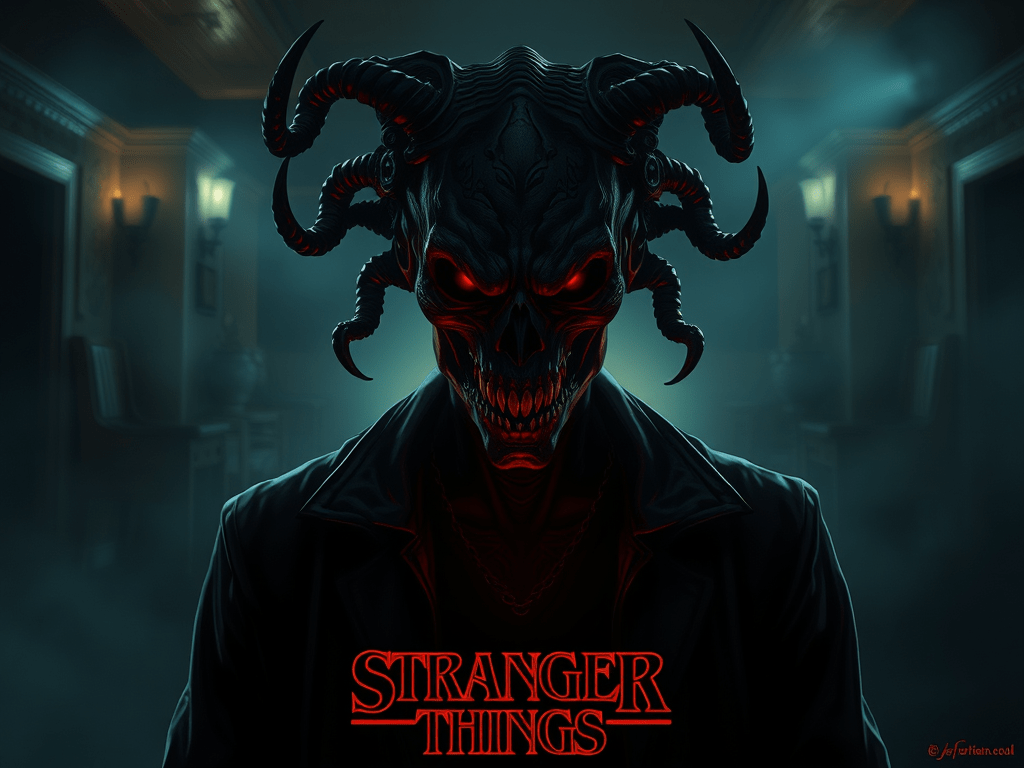
Stranger Things is often associated with nostalgia—synth-heavy soundtracks, small-town Americana, and the familiar iconography of 1980s adventure stories. Yet its enduring psychological grip has far less to do with retro aesthetics than with what the series quietly dramatizes about the human mind. Beneath the spectacle of monsters and alternate dimensions lies a sustained meditation on repression, trauma, and the cost of refusing to confront pain. At its deepest level, the story is not about an invasion from elsewhere, but about what happens when suffering is pushed out of awareness and left to evolve on its own.
This theme is most clearly embodied in the Upside Down—and ultimately in the figure of Vecna, who represents what unhealed trauma becomes when it is ignored long enough to acquire coherence, intention, and power.
The Upside Down as the Shadow Psyche
The Upside Down functions as a remarkably precise metaphor for the unconscious mind. It exists parallel to the waking world, mirroring it while remaining unseen, much as repressed psychological material exists alongside conscious awareness. Everything in this shadow realm appears frozen in time, overgrown and decaying, reflecting how unprocessed emotional experiences do not develop or resolve. Instead, they remain suspended, waiting for the conditions that allow them to resurface.
In depth psychology—particularly in Jungian theory—the shadow refers to the aspects of the self that the ego refuses to identify with. These are not inherently negative traits; they are often emotions, needs, or memories that once felt unsafe to express. Anger may have threatened attachment, grief may have felt overwhelming, and vulnerability may have invited harm. Repression becomes a strategy for survival. However, what is repressed is not destroyed. It is merely relocated.
Stranger Things repeatedly illustrates this principle. The barrier between Hawkins and the Upside Down is thin, porous, and unstable. Under sufficient stress, it fractures. Psychologically, this suggests a sobering truth: no matter how thoroughly pain is buried, it remains active. When ignored long enough, it begins to assert itself in ways that feel intrusive, irrational, or monstrous.
Vecna as Unhealed Trauma Personified
Vecna is not a random villain emerging from chaos. He is a logical endpoint. Where previous threats in the series operated as impersonal forces, Vecna is intentional and discerning. He seeks out individuals already carrying unresolved guilt, shame, grief, and self-contempt. Crucially, he does not create these wounds. He recognizes them.
This distinction reveals the show’s deeper psychological argument. Trauma does not need to be inflicted again in order to be destructive. Once internalized, it can become self-sustaining. Vecna’s power is derived from fractures in identity that were never repaired, only avoided. In this sense, he is not an external enemy so much as an embodiment of internal collapse.
Trauma, when left untreated, does not remain an isolated experience. It reshapes perception, meaning-making, and self-concept. Over time, it becomes part of how a person understands who they are and what the world is like. Vecna represents this transformation—the moment when pain stops being something that happened and becomes something that is.
The Slow Evolution of Ignored Trauma
The trajectory of Vecna mirrors the psychological evolution of unhealed trauma with unsettling accuracy. It begins with an overwhelming experience—loss, abandonment, helplessness, humiliation, or fear—that exceeds the individual’s capacity to cope. At the moment it occurs, repression can be adaptive. It allows the psyche to continue functioning when safety, support, or understanding are absent.
However, when that pain is never revisited in a context that allows for processing, it begins to distort meaning. The experience hardens into belief. The individual may come to see themselves as broken, culpable, or fundamentally different from others. These interpretations are not chosen consciously; they emerge as the mind’s attempt to impose order on chaos.
Over time, these beliefs encourage withdrawal. Emotional closeness feels risky. Dependence feels humiliating. The inner world grows louder while the external world becomes increasingly threatening or irrelevant. Emotional energy that is never expressed does not fade away. Rage, fear, grief, and shame accumulate in the unconscious, gaining intensity precisely because they are denied acknowledgment. Eventually, what cannot be held internally seeks expression externally.
In everyday life, this process may manifest as chronic self-sabotage, emotional numbness, explosive anger, or patterns of destructive relationships. In Stranger Things, it takes on a symbolic form. Vecna is trauma that has organized itself—pain that has learned how to move, speak, and destroy.
Memory as the Battlefield
Vecna’s most unsettling quality is not his physical violence, but his psychological method. He attacks through memory. His victims are not overwhelmed by new horrors, but by old ones they never resolved. Intrusive thoughts, shame spirals, and emotional paralysis flood their consciousness until past suffering collapses into the present moment.
This portrayal aligns closely with the lived reality of trauma. Traumatic memories are not stored like ordinary recollections. They are encoded somatically and emotionally, often outside of narrative language. When triggered, the nervous system responds as though the original threat is occurring again. The body does not recognize that time has passed.
Vecna’s power lies in exploiting this collapse of temporal boundaries. His victims are not defeated by a lack of strength, but by the mind’s inability to distinguish what was from what is. The show makes a quiet but devastating point: unresolved trauma does not stay in the past. It waits for an opening.
A World Where Institutions Fail
Another reason Vecna resonates so deeply is the broader environment in which he operates. Throughout Stranger Things, institutions meant to protect—governments, laboratories, authorities—repeatedly fail or cause harm. Children and adolescents are left to navigate overwhelming threats with limited guidance. Psychologically, this mirrors the experience of many people whose trauma originated in contexts where safety should have existed but did not.
When external structures fail, the psyche adapts by becoming hypervigilant and self-reliant. This adaptation may ensure survival in the short term, but it often leaves deep scars. Vecna can be understood as the internalization of a world that felt hostile, unpredictable, or abandoning. He is what happens when the burden of meaning, protection, and control is placed entirely on the individual psyche.
The Central Warning of
Stranger Things
The series delivers a consistent and understated warning: pain that is ignored does not remain passive. Left unintegrated, trauma grows more rigid, more hostile, and more influential. It begins to shape perception, behavior, and identity from beneath the surface. Vecna is not born of inherent evil; he is born of prolonged avoidance.
In this sense, Stranger Things reframes horror. The true threat is not fear itself, but silence—the refusal to acknowledge what hurts. What is denied consciousness does not weaken. It organizes.
Integration as the Only Real Antidote
Importantly, the show does not suggest that force alone can defeat Vecna. Weapons, aggression, and domination repeatedly fall short. What weakens him are acts of integration. Music anchors characters to identity when dissociation threatens to take over. Friendship provides external regulation when internal regulation fails. Speaking the truth of one’s pain breaks the isolation that gives trauma its power.
This mirrors a fundamental principle of psychological healing. Trauma loses its grip not when it is erased, but when it is brought into conscious awareness within a context of safety and connection. What is acknowledged can be contextualized. What is shared becomes tolerable. Integration does not eliminate pain, but it prevents pain from becoming malignant.
Why This Story Speaks to the Present Moment
Vecna resonates because contemporary audiences are living in conditions that foster repression. Chronic stress, social fragmentation, and emotional overextension have normalized functioning while unwell. Many people move through their lives carrying unresolved grief, shame, and fear beneath a veneer of competence.
Vecna embodies the anxiety that accompanies this way of living—the sense that something is building beneath the surface, waiting to erupt. He represents what we fear becoming if we continue telling ourselves that we are fine, that it does not matter, that we will deal with it later.
Conclusion
At its deepest level, Stranger Things is a psychological parable. The Upside Down is not somewhere else—it is within us. Vecna is not an invader—he is an accumulation. The series suggests that the most dangerous monsters are not born in darkness, but in silence, and that healing does not begin with denial, but with the courage to turn toward what has been avoided.
In confronting the shadow, Stranger Things offers a quiet reassurance: pain acknowledged loses its power to dominate. What is faced can be integrated. And what is integrated no longer needs to become a monster.
 Medal Mind
Leave a comment