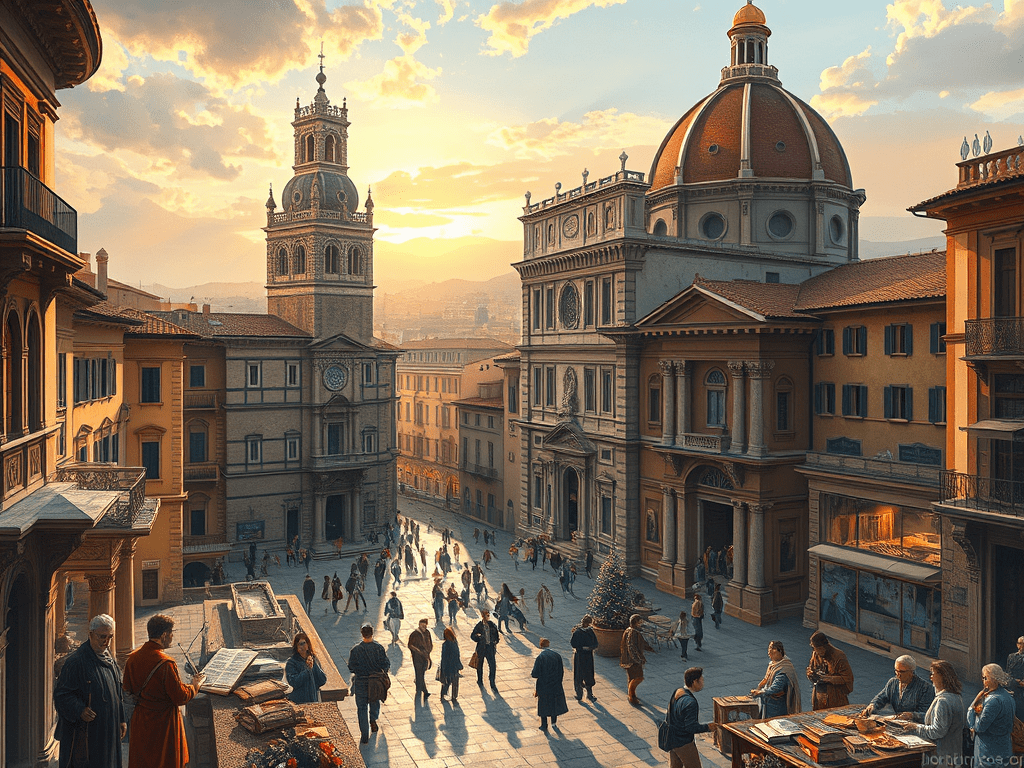
The Renaissance was a period of profound cultural, artistic, and intellectual rebirth that awakened a new sense of human potential. It was a time when the boundaries of what people thought was possible began to expand. Through art, science, philosophy, and literature, Renaissance thinkers celebrated human beings’ ability to shape their world, explore new frontiers, and develop their talents. The movement stands as a testament to the power of individual creativity, innovation, and self-improvement—values that resonate deeply today.
In this article, we explore the origins of the Renaissance, key figures, philosophical themes, and parallels to our modern understanding of personal growth.
Country, Culture, and Time Period
The Renaissance flourished primarily in Italy, spreading throughout Europe from the 14th to the 17th centuries. It began in cities like Florence, Venice, and Rome, where trade wealth and patronage allowed the arts and intellectual pursuits to thrive. Eventually, Renaissance ideas spread to France, England, the Low Countries, and Spain, sparking similar developments across the continent. The term “Renaissance” means “rebirth,” referring to the revival of classical ideals from ancient Greece and Rome—but this was more than just a return to old ideas. It was a dynamic period of reinvention and expansion, where new perspectives on art, science, and humanity emerged.
The Renaissance is often described as a cultural bridge between the Middle Ages and the modern world. Medieval Europe had been dominated by rigid social structures and the authority of the Church, with a strong focus on salvation and the afterlife. In contrast, Renaissance culture celebrated human achievement in this life, encouraging people to cultivate their talents and explore the world around them.
Historical Background: A World in Transition
The Renaissance began in the aftermath of the Black Death (1347–1351), a pandemic that wiped out a third of Europe’s population. This immense tragedy led to a shift in how people viewed life and death. Instead of focusing solely on the next world, many began to explore the value of life here and now. With so much upheaval, new opportunities emerged—feudal structures began to crumble, cities grew in importance, and wealthy merchant families rose to power, particularly in northern Italy.
Florence, often regarded as the cradle of the Renaissance, was home to influential families like the Medicis, who became patrons of artists, scholars, and thinkers. The influx of Greek and Roman texts—preserved by Islamic scholars and rediscovered in European libraries—provided fresh intellectual material. Philosophers, artists, and scientists began to rethink their place in the cosmos, embracing individual potential and the idea that humans could shape their destiny through knowledge and creativity.
The Movement: Renaissance Humanism and Its Leaders
Central to the Renaissance was the movement known as Humanism, which placed human beings at the center of inquiry. Humanists believed that individuals were capable of great achievements through education, reason, and artistic expression. They sought to harmonize classical wisdom with contemporary life, rejecting the idea that human nature was inherently sinful or bound by fate. Instead, they celebrated free will, personal responsibility, and intellectual pursuit.
Renaissance thinkers rediscovered the works of Plato, Aristotle, and Cicero, applying their insights to ethics, politics, and art. They also emphasized the human form—both physically, in sculpture and painting, and philosophically, in the idea that individuals could refine themselves through practice and learning.
Among the key figures of the Renaissance were artists, scientists, writers, and philosophers, many of whom embodied the idea of multifaceted genius—the belief that a person could excel in multiple fields.
Leaders of the Renaissance: Pioneers of Human Potential
One of the hallmarks of the Renaissance was the rise of extraordinary individuals who personified the idea that human potential has no limits. Their lives and works remain some of the most celebrated examples of what people are capable of achieving when they pursue knowledge and creativity.
Leonardo da Vinci (1452–1519) is perhaps the most famous example of the Renaissance ideal. A painter, inventor, scientist, and mathematician, Leonardo represents the concept of the “Renaissance Man”—a person of many talents. His sketches of human anatomy, flying machines, and military devices illustrate his belief that no field of knowledge should be off-limits.
Michelangelo (1475–1564), another Renaissance giant, combined art with philosophical reflection. His sculptures, like the David, emphasized the beauty and power of the human body, portraying individuals not as passive beings but as active, powerful agents. His work on the Sistine Chapel ceiling embodies the Renaissance’s blend of spirituality and humanism, presenting biblical figures with a deeply personal, human quality.
In the realm of politics, Niccolò Machiavelli (1469–1527) explored the dynamics of power and personal responsibility in his book The Prince. Far from being a mere manual on manipulation, The Prince emphasizes the importance of adaptability, realism, and pragmatic action—themes that align with the Renaissance idea of shaping one’s own future.
In literature, Dante Alighieri, Francesco Petrarch, and Giovanni Boccaccio pioneered new forms of expression, writing in the vernacular language (instead of Latin), making their works accessible to a broader audience. Their poetry and prose reflect a deep understanding of the human condition, celebrating personal experience, love, and moral reflection.
Philosophy: The Renaissance Vision of Human Potential
The core philosophy of the Renaissance lies in the belief that human beings are capable of continuous growth and self-improvement. Unlike earlier medieval thought, which often viewed human nature as inherently flawed, Renaissance thinkers emphasized the inherent dignity and worth of the individual. They saw education, art, and science as pathways to fulfilling that potential.
One of the guiding principles of Renaissance Humanism was the idea that knowledge is transformative. By studying the liberal arts—history, literature, philosophy, and science—individuals could cultivate their minds and improve their character. Education was not just about practical skills but about becoming a better, more complete person.
This idea is reflected in the Renaissance concept of “Virtù,” a term that refers not only to moral excellence but also to the ability to shape one’s life and circumstances through effort, creativity, and willpower. Virtù was seen as an essential quality for both rulers and ordinary citizens, emphasizing that everyone had the potential to lead a meaningful, impactful life.
Parallels to Today: Unlocking Human Potential in the Modern Era
The Renaissance’s celebration of human potential and self-cultivation remains deeply relevant today, especially as we navigate a world that demands adaptability, creativity, and personal responsibility. The idea that we can improve ourselves through education, discipline, and artistic expression resonates with modern movements focused on personal development and lifelong learning.
In many ways, the Renaissance’s vision of multifaceted individuals mirrors contemporary ideas about polymathy—the belief that people should not limit themselves to one field but explore multiple interests. Just as Leonardo da Vinci refused to be confined by a single discipline, today’s thinkers, entrepreneurs, and creators thrive at the intersection of art, science, and technology.
The Renaissance also offers insight into the importance of mindset. Its thinkers embraced a growth-oriented philosophy, believing that failure and setbacks were opportunities for learning rather than barriers. This same mindset is reflected in modern concepts like grit and resilience—the ability to persist through challenges and grow from them.
Perhaps most importantly, the Renaissance reminds us that human flourishing is a collaborative effort. While personal growth is important, the Renaissance thinkers understood that individual achievements are most meaningful when they contribute to the larger community. In an era marked by both individualism and social fragmentation, this lesson feels more relevant than ever.
Embracing Renaissance Values Today
The Renaissance was not just a time of artistic masterpieces and scientific discoveries—it was a movement that redefined what it means to be human. It challenged individuals to embrace their potential for greatness through knowledge, creativity, and discipline. It celebrated the idea that each person has the ability to shape their own destiny and make a meaningful contribution to the world.
In today’s fast-changing world, the lessons of the Renaissance still resonate. We, too, are called to explore our talents, develop our minds, and take responsibility for shaping our futures. Like the thinkers and artists of the Renaissance, we can embrace the idea that our potential is boundless—and that through continuous learning and self-improvement, we can create lives filled with meaning and purpose.
Just as the Renaissance reawakened the spirit of human potential, we, too, can awaken our own. It is not only through grand achievements but also through the daily pursuit of growth that we unlock the fullness of our potential. As the Renaissance teaches us, the journey toward a richer, more meaningful life is always within our reach.
The Weight of a Fixed Identity
A fixed self-identity is often shaped by societal expectations, past experiences, or cultural norms. During the Renaissance, many were constrained by traditional roles—peasants, merchants, or clergy—and found it difficult to envision a different life. Similarly, in modern times, people often confine themselves to identities such as “I’m not creative,” “I’m not a leader,” or “I’m just an average person.” These mental boundaries become self-fulfilling, limiting the scope of our ambitions and stifling our ability to explore new paths.
For example, someone who dreams of becoming an artist might hesitate to pursue this passion because they have internalized the belief that they are “not talented enough” or that it is “too late to start.” In reality, these are constructs of the mind, not objective truths. Renaissance thinkers like Leonardo da Vinci rejected such constraints, pursuing diverse interests and mastering multiple fields despite challenges and setbacks.
Overcoming Identity-Based Barriers
To embrace the Renaissance spirit of potential, it is essential to question the narratives we tell ourselves about who we are. These narratives often reflect fear of failure, judgment, or stepping into the unknown. By reframing identity as fluid and evolving, we allow ourselves the freedom to explore, grow, and redefine our capabilities.
1. Adopt a Growth Mindset: A key lesson from Renaissance humanism is that growth is a lifelong process. Embrace the belief that abilities can be developed through effort and learning, rather than being fixed traits.
2. Challenge Limiting Beliefs: Reflect on areas where your self-identity may be holding you back. For instance, ask, “What would I pursue if I didn’t think this was ‘off-limits’ for me?” Write down those dreams and explore small, actionable steps toward them.
3. Redefine Success: Renaissance figures valued the process of learning and creating as much as the outcome. Reframe success not as perfection but as progress—an ever-unfolding journey of discovery.
4. Seek Inspiration from Others: Surround yourself with stories of people who defied expectations and redefined their lives. The Renaissance is rich with such examples, from self-taught artists to revolutionary scientists.
Your Renaissance Moment
As the Renaissance teaches, unlocking human potential begins with the courage to dream beyond the boundaries of identity. You may already possess the skills and curiosity to pursue something new, but fear of breaking away from a familiar role may be holding you back. Whether it’s a career, creative pursuit, or personal change, ask yourself: “Am I allowing my self-identity to stop me from becoming who I want to be?”
The Renaissance reminds us that transformation is always possible. By questioning who we think we are and allowing ourselves the freedom to explore, we can awaken a deeper, truer potential—one that, like the achievements of the Renaissance, can leave a lasting mark on the world.
 Medal Mind
Leave a comment